The Earth Remembers: Moroccan Clay
Ghassoul clay has been used in North Africa for 1,500 years. Here is why it still cannot be replaced.
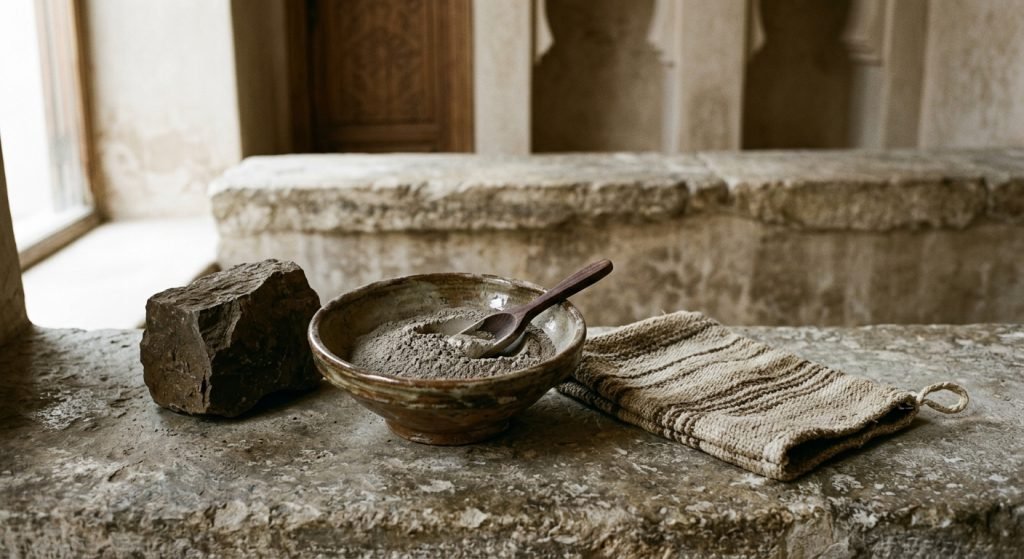
In the Middle Atlas mountains of Morocco, deep within ancient volcanic rock formations, lies one of the world’s most unusual minerals. Ghassoul — also written as Rhassoul — is a rare smectite clay found almost exclusively in the Moulouya river basin near the town of Tazouta. For fifteen centuries, it has been traded, refined, and used in Moroccan hammams as the definitive purifying agent.
What makes Ghassoul exceptional is its extraordinary swelling capacity and cation exchange ability. In simple terms: when mixed with water, the clay’s molecular structure expands and actively draws out impurities, excess sebum, and surface toxins from the skin. It binds to these substances and removes them completely when rinsed — without stripping the skin of its natural moisture balance. No synthetic surfactant can do this as cleanly.
Unlike most clays, Ghassoul is naturally rich in silica, magnesium, potassium, and calcium — minerals that actively support skin function rather than merely cleansing it. The result is skin that is not just clean but balanced: sebum-controlled without dryness, clarified without irritation. This is why it has always been used on hair as well as skin in the hammam tradition.
Our Desert Clay soap carries Ghassoul as its primary active, supported by olive oil and rosemary extract. It is formulated for oily and combination skin but works beautifully on anyone who finds conventional soaps too stripping. The texture is smooth and firm, the lather earthy and grounding, the effect on pores immediate.
The clay in each Desert Clay soap came from the Middle Atlas. It was formed millions of years ago by volcanic activity, deposited in layers between ancient stone. When you wash with it, you are using something the earth spent an extraordinary amount of time making. That is worth a moment of consideration.
Amira El Fassi
Founder · January 2026
-300x164.png)
-300x164.png)